At just four years old, Aronyak Ghosh stumbled upon a dusty box of chess pieces while his mother cleaned the house. The set belonged to his father, Mrinal Ghosh, but to the child, it was something entirely different. The black-and-white pieces looked like soldiers, and the chessboard became a battlefield. As he moved them across the floor, unknowingly staging a war, his father watched in stunned silence. That quiet moment would go on to shape the course of their lives.
Mrinal, who had once played chess casually, felt something shift as he observed his son’s instinctive fascination. It was then that he decided chess would not just be a pastime, but an essential part of Aronyak’s life. In an unexpected twist, the father himself returned to the game with renewed passion, eventually competing seriously and earning an official FIDE rating.
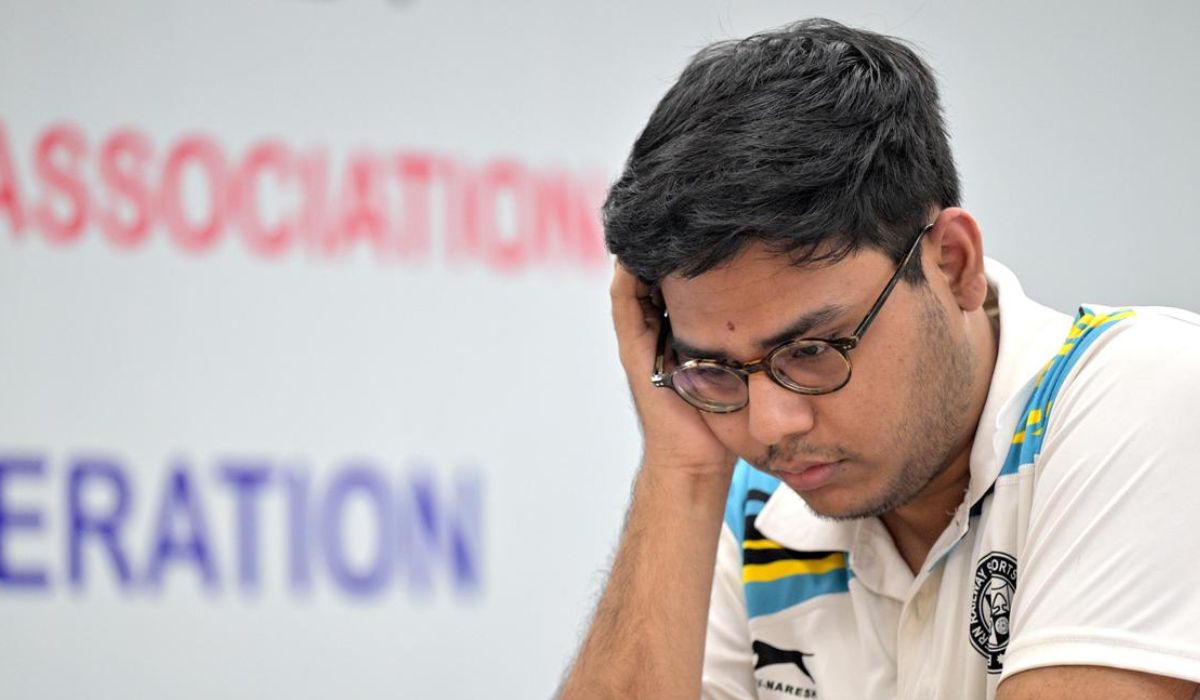
Years later, that early spark has culminated in a historic achievement. Aronyak Ghosh has now become India’s 95th Grandmaster, securing the title after an impressive performance at the 23rd BCC Open 2026 in Bangkok. With an unbeaten score of 7 out of 9 and a performance rating of 2584, he clinched his long-awaited third and final GM norm.
For the Ghosh family, this milestone carries far more weight than a sporting title. It marks the end of years filled with sacrifice, uncertainty, and relentless effort. Having crossed the 2500 ELO mark earlier and earned his first GM norm in 2022, the final step had remained frustratingly out of reach for nearly four years.
“It is entirely a relief,” said his mother, Sanchita Ghosh, speaking from Bangkok. She added, “As parents, after leaving everything behind, even setting aside academics, this is a huge relief for us. It means that what we committed to has finally succeeded.”
The journey was anything but easy. Coming from a modest background, the family had to make difficult and often painful choices. Mrinal, who later became a chess arbiter, sometimes sold household belongings just to cover tournament fees and travel expenses. Financial stability was never guaranteed, and every opportunity to compete came with pressure.
“We didn’t receive much financial support,” Sanchita recalled. “Most of the time, we depended on his prize money to fund further tournaments. It was always reinvested. At a very young age, he understood that winning prize money was necessary to keep playing. He used to think that if he played too aggressively and lost, he wouldn’t have the funds to continue.”
This constant pressure shaped Aronyak’s mindset early on. Unlike many of his peers, who benefited from sponsorships, his ability to participate in future tournaments often depended entirely on his current performance.
His introduction to competitive chess came at the Under-7 Nationals, but the experience was overwhelming. “After every round, he would ask about the opponent’s state and rating. It was very stressful for him,” his mother shared.
Recognizing the need for structured training, the family sought guidance from coach Sarbajit Adhikari, who helped Aronyak build the stamina required for long matches. He later trained at the Dibyendu Barua Chess Academy before moving to Alekhine Chess Club, where his game began to evolve significantly.
It was there that he met Soumen Majumdar, affectionately known as Somen Da, whose influence proved transformative. Under his mentorship, Aronyak adopted rigorous training routines, often practicing eight to nine hours a day. Despite the family’s financial struggles, Somen Da supported himself unselfishly.
“Somen Da would have been the happiest if he were alive today,” Sanchita said. “He didn’t get to see Aranyak become a Grandmaster. He always used to say: ‘Do not just aim for 2500, aim for 2600’.”
Even with such an intense focus on chess, Aronyak continued his education, completing his schooling at South Point School and later pursuing a B.A. degree. He also secured a job with Eastern Railway, providing some degree of financial stability.
In recent months, his performances have reflected his steady rise. He won the National Rapid title and contributed to a third-place finish for his team at the 45th National Team Championship. By the time he arrived in Bangkok, he was already seen as a “GM-in-waiting.” His earlier norms in Barcelona (2022) and France (2024) had set the stage, and the final breakthrough finally came in Thailand.
Yet, for Aronyak, the Grandmaster title is not the end, it is a beginning. It offers him the freedom to play without the constant burden of financial uncertainty tied to each move.
Sanchita makes it clear where his future lies: “There’s nothing else. He hasn’t done anything else besides chess. It’s not possible now to switch to academics. The time to build that foundation was already devoted entirely to chess. Chess is the primary thing. Everything else is secondary.”